

The Blog
 Posted on October 10, 2013
 by M.T.
  0
0 As I mention below, I had the pleasure of sharing a panel with Sinan Antoon last Saturday at the Page Turner literary festival. Sinan noted, at that panel, the dense, suffocating weight of western constructions of other places and peoples so much so that it begins to seep into our sense of ourselves so that it now, for instance, not uncommon to find casual reference to Pakistan’s Tribal Areas as a kind of “wild west” frontier (or, alternatively, to hear about groupthink by classes of people as “tribalism”). The extension of that imagination –and therefore, implicitly of a network of related ideas: civilization, manifest destiny, noble savage– is both prelude and effect of the terror wars. I have been working on an article that touches on some of this. In the meantime, below, here are some examples, in no particular order (other than rough chronology) of the appearance of the “wild west”/ frontier trope in western writing on Pakistan:
The Federally Administered Tribal Areas (FATA) is Pakistan’s impoverished, wild west region, bordering Afghanistan, where the Taliban and al Qaeda have established a stronghold to plan their attacks on Kabul, Islamabad, and New York City. —Foreign Policy, Nov 04, 2009
Dara, a dusty, Wild West-type town, crawls with intelligence agencies, drug smugglers and gun-toting Pathan tribesmen. —The Telegraph, Dec 02, 2005
Dealing with Pakistan’s Wild West —The Globalist, Jan 24, 2008
“It’s the wild west of the 18th century,” says Imtiaz Gul, Pakistani journalist and author of “The Most Dangerous Place: Pakistan’s Lawless Frontier.”
“People are like the old time Wild West, adventurous creatures who grew up with guns, who grew up with a lot of adventurism and who are pretty partially alien to the culture of United States, or for that matter even the culture of Islamabad. —PBS NewsHour Jun 15, 2010
Darra Adam Khel, a small burg in Pakistan’s tribal areas, is the quintessential frontier town. Picture Wyatt Earp sashaying down the streets of Tombstone in a turban, and you begin to get the idea. —Washington Post, Mar 30, 2008
Pakistan’s Wild West – A Photo Essay —TIME
Waziristan -Pakistan’s Wild West (Video) —FORA.TV on Dailymotion
There are more guns for him to choose from in Darra Adam Khel, the nearest thing Pakistan has to a Wild West town.
In fact, guns are about the only things made and sold in this dusty one-street town near Peshawar, capital of the country’s unruly Northwest Frontier Province bordering Afghanistan. —LA Times, Sept 27, 1987
A Wild Frontier – It will take more than American missiles to bring order to Pakistan’s north-western border region —The Economist, Sept 18, 2008
If Peshawar is the Wild West with electricity, then Lahore is Southern California in the 1950s without the beaches. —Rug Review, Feb 1989
Rudyard Kipling described this dusty frontier capital near the Khyber Pass as a “city of evil countenances.” Other cities lived, Peshawar lurked. Even the shadows here had shadows. —LATimes May 12, 1986
Pathans Rule the Wild West —The Independent, Jun 03, 1999
Wild West Pakistan —The Age, Jan 29, 1980
It is an economy and society evoking an image of the American Wild West —Christian Science Monitor, Dec 06, 1982
Wild West Alive, Well in Pakistan (also on Darra Adam Khel) —The Lewiston Daily Sun, Nov 21, 1973
These two provinces, called the “wild west” of Pakigtan (sic) —NYT, Mar 29, 1973
Asked why many of his opponents suddenly find themselves up for murder, Bhutto said it was all part of the “Wild West” atmosphere of Pakistan politics —Lewiston Evening Journal, Mar 12, 1973
“Shooting started last Thursday,” he continued, “and all hell let loose Friday. It was just like the Wild West.” East Pakistan Refugees Tell of Mass Executions, The Milwaukee Sentinel, Apr 07, 1971
BOOKS
Warrior Poets: Guns, Movie-Making and the Wild West of Pakistan 2008
I had ventured into Pakistan’s wild west and I had the scars to prove it. Muslim Cleavage 2011
Peshawar is the capital of Pakistan’s “wild west” Three Cups of Tea 2009
Peshawar Pakistan is the archetypal wild-west frontier town Force Valor – Revenge (Vol 1) 2013
For Special Forces, Afghanistan was the wild wild West, and the new Ranchers reveled in it. —The Hunt for Bin Laden: Task Force Dagger 2003
Here’s an interview with me about life under drones. I’ll be presenting on the same topic at the Drones and Aerial Robotics Conference this Friday at NYU.
Last week I had the pleasure of presenting along side Sinan Antoon and Amitava Kumar at the PageTurner literary festival. I think an audio or video of that event will be available at some point.
Full Interview HERE. Oct 04.2013:
PG: Is there a political solution possible in Waziristan?
MT: The U.S. has to leave, but they also have to stop funding the Pakistani establishment, and they have to start taking the Pakistan civilian government seriously. The tribal areas also need to be incorporated into Pakistan. How this is done is up to them, but the services of the state need to be extended to that area. There is a whole range of socio-political issues, which need to be resolved. They will require money and also will among political leaders, but this is impossible as long as the United States continues its meddling, occupation, and funding of the Pakistani political establishment.
PG: What do Americans most need to understand about the drones in Pakistan?
Distinguished Professor of Geography, Derek Gregory, at the University of British Columbia in Vancouver wrote up a thoughtful post on WOUNDS and connects it to his own work. It’s chock full of useful links and footnotes to other relevant readings on drone warfare. Here’s a snippet:
This matters so much – and reappears in a different form in ‘Moving targets’ – because the contemporary individuation of ‘war’ (if it is war) works to sanitize the battlefield: to confine attention to the individual-as-target (which is itself a technical artefact separated from the exploded fleshiness that flickers briefly on the Predator’s video screens) and to foreclose the way in which every death ripples across a family, a community…
Read the whole thing here.
We’ve got just $800 more to go! And, 14 days left. Thank you to all of you have supported us. Please help spread the word as we make the final push.
I just wanted to make a quick note of a few things here: First, I’ll be presenting at the DARC conference along with Shahzad Akbar, the lawyer who has been demanding justice for drone affectees as well as filmmaker and academic Wazhmah Osman. You can find out more about our panel and register here.
I’ll also be doing a reading at Page Turner, a festival by the Asian American Writers’ Workshop on October 5th. Festival details here.
I’m slowly getting to pulling together various appearances, articles, talks, etc. Here’s a piece in the Sunday Guardian about Wounds of Waziristan. Below is a video from MSNBC’s Chris Hayes:
Visit NBCNews.com for breaking news, world news, and news about the economy
From the archives – while researching for Wounds, we came across this Reagan dedication of the space shuttle, Columbia, to the Afghan resistance. Enjoy!
So, what is this business about haunting? WOUNDS is a film that reflects on what it means to be haunted. In his address on May 23rd this year, President Obama claimed that he is “haunted” by the loss of civilian life from the drone attacks and wars carried out on his orders.
Let’s take this seriously. What is haunting?
This film focuses on the people who live in Waziristan and who live among loss. Material conditions, whether it’s the rubble after a drone attack or the grave of one’s kin, persist in reminding the living what they have lost.
***
In their essay “On the Theory of Ghosts,” the German intellectuals Adorno and Horkheimer wrote:
Only the conscious horror of destruction creates the correct relationship with the dead: unity with them because we, like them, are the victims of the same condition and the same disappointed hope.
Only the conscious horror of destruction creates the correct relationship with the dead.
I’ve been writing and speaking for some time about the limitations of international law as a language through which to think and speak about drone attacks. International law is slow. Missiles are fast. International law is caught up in constructing the proper order of violence. In other words, it doesn’t reject drone attacks or imperial power as such; it only raises objections when it finds that the violence has become excessive. This is not to deride legal work, but to point out what it constitutively is: a method to regulate the status quo.
It’s not so much lawyers, but journalists actually, who have popularized legal language as the only frame through which we can talk about drone attacks and moral standards. Journalists regularly fail to look beyond the usual “experts” in policy and legal circles to other fields that may have an alternative to offer. We are becoming vulgar empiricists who seem to think that a truth not attached to a number (say, the number of “militants” vs. “civilians” killed), or a legal rule (for example: whether an action does/does not violate international law) is no truth at all.
We forget that our categories are also an ideological construct. (All categories are.)
So, what is an alternative language to use to think about drone attacks? I think haunting is one frame through which one can re-direct the conversation from issues of legal standards to the lives lived and lives lost under the drones in Waziristan and elsewhere. The questions then turn on the material conditions and the loss suffered–not as evidence for legal arguments but as queries about what it does to a person to live in such conditions. The question is not, ‘Do I stick him in the “militant” or “civilian” column?’ but instead, who survives him? How do they deal with that loss? What is it like to live among the rubble?
It isn’t through legal standards but though trying to understand the horror of the destruction that we create the correct relationship — with the dead, yes — but with the living, too.
If our task as journalists — not the MSM who get paid a lot to shill for power — but the rest of us, in fact most of us: if our task is not to establish the humanity of others, then we might as well stop writing.

WOUNDS‘ graphics and animations editor, AJ Russo, working double time and rocking the graphics for the film. You can check out more of AJ’s spectacular work here and here. I think one of the more wonderful aspects of working on a film is how much of an intensely collaborative process it is –quite unlike print journalism or academia, the other two worlds which I inhabit.
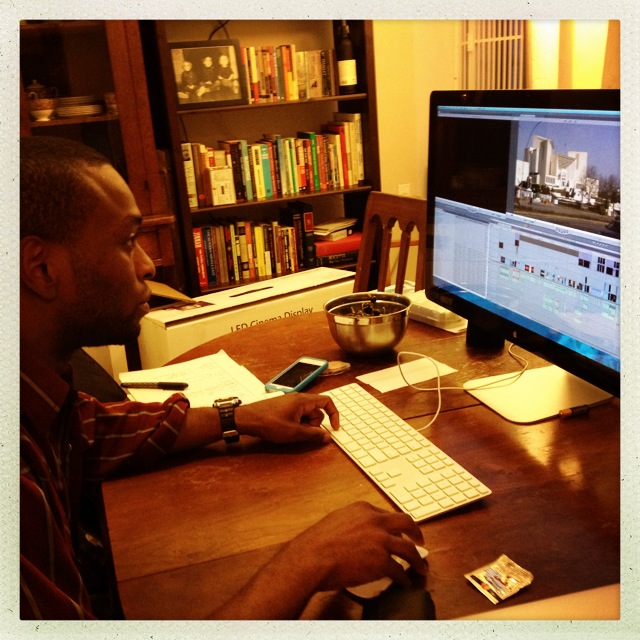
A photo from a few days ago: one of our editors, Messiah Rhodes, working hard on our film in my cluttered space. Our “studio” is my dining room table. There’s a little Tulsi packet there too, next to the mouse – a little bit of the Pakistani streets – and my addiction when I am working well into the stupid hours of the morning.
I’ve just gotten off the phone with contacts/colleagues.
Here’s another example of the fall-out from cycles of violence in FATA, particularly Waziristan–fall-out that goes largely unreported and undiscussed in the national and international media. That silence only adds to the prevalent image of “backward tribals,” enraged Muslims and inexplicable violence when people in these regions do resort to armed resistance and/or stubborn refusal to work with the state.
First, recall this little reported story: 17 Pakistani soldiers were killed and scores more wounded when a car packed with explosives detonated near two fuel tankers at a military post in North Waziristan’s capital, Miranshah. The blast at Esha checkpost flattened two residential barracks last Saturday evening (Mar 23rd).
This is what happened after: the army imposed a 24-hour curfew in all of North Waziristan, one that is still ongoing 4 days later. The curfew was announced by the political administration. Shoot-on-sight orders have been given.
No services–including emergency services like ambulances–are reportedly allowed to run. Students at Miran Shah College have been unable to leave their hostels and have therefore missed some of their matriculation exams. Until at least Monday, approximately 350 vehicles and their passengers were stranded on the road between Bannu, a settled area in KP and Miranshah (ET). People are running out of basic supplies while businesses and vendors suffer losses as perishable supplies like vegetables and fruit rot. Some families have been reduced to eating shaftal or alfalfa, the fodder they usually give their livestock.
It is these daily cycles of brute force coupled with rank neglect that fuel support for insurgents who can then pose as resistance against a brutal regime. In other words, a gaping political vacuum exists in FATA, to which drones seem like an absurd response.
And finally, this is the first time that political parties will be allowed to operate and to contest elections from the Tribal Areas. Residents of FATA did not gain the right to vote till 1996, and although they were able to elect representatives to Parliament, these candidates had to run as independents. This year, however, parties have been given permission to carry out activities within FATA. In either case however, the Pakistani citizens here are in the bizarre position of electing representatives to an electoral body–the Parliament–whose laws do not apply to FATA. That questionable democratic process was further stymied by the curfew because candidates were unable to submit their paperwork for elections by the deadline this Sunday (Mar 24th).
Originally published March 27. 2013